|
||||||||||||||||||||
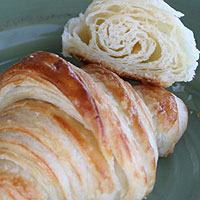
The thought of making croissants sounded intimidating, but I wanted to try. Of course after several failed attempts (pictured below), I got them right. I certainly don't claim them to be a French quality croissant, but they are delicious. They are pillowy-soft and inside and crisp and flaky on the outside. |
||
Before you begin, it's good to understand what a croissant is. Basically it's just layers of dough and butter. You will be making the dough and enclosing a block of butter inside, rolling it out, folding it, rolling it out, resting, etc. Until there are 36 very thin layers of butter and dough. Minimum time: 7 hours |
||
Phase 1 |
||
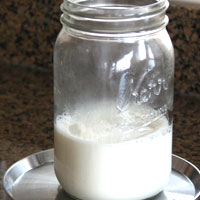
Measure a bit more milk than you will use and heat in the microwave until boiling. Re-measure and let cool until warm/hot (105-110 degrees). |
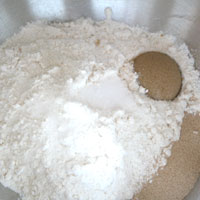
Measure and stir the remaining dough ingredients. Add the milk and knead five minutes. |
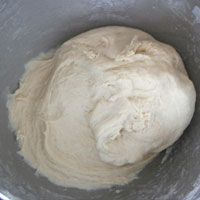
The dough should be smooth, soft, and tacky (not sticky or dry). |
1 c + 2 T (9 oz) milk scalded 2 1/3 c (12 oz) all purpose flour 2 t instant yeast 1 T brown sugar 1 ¼ t salt Some milk will be lost due to evaporation, so make sure you scald a little extra and measure it again afterwards. |
||
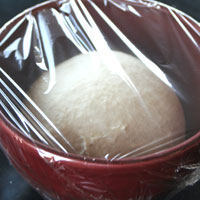
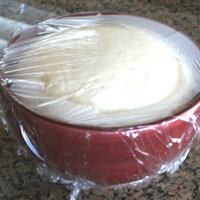
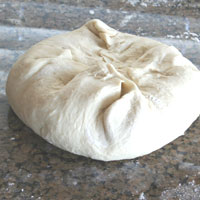
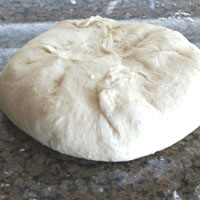
Shape into a ball and refrigerate covered in plastic wrap 90 minutes. |
The dough after 90 minutes. |
|
|
Phase 2
|
||
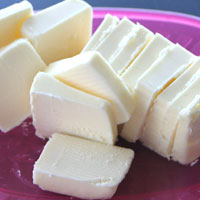
Five to ten minutes before removing the dough from the refrigerator cut the butter roughly into tablespoon size.
|
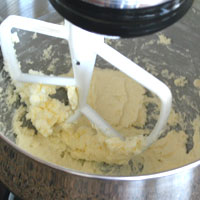
Beat in an electric mixer with the paddle attachment. Beat until the butter is completely pliable with no lumps. You will probably need to scrape the paddle and sides of the bowl to achieve this. Keep the butter as cold as possible. |
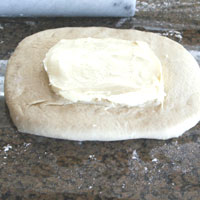
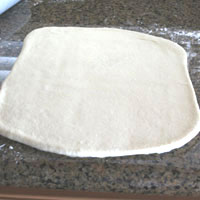
Remove the dough from the refrigerator and roll out into a 6 x 6 inch square. Place the butter in the center of the dough and form it into a 3 x 3 inch square. |
3/4 c (6 oz) unsalted butter |
||
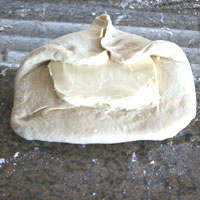
Fold the corners onto the center of the butter. |
Try to make all of the sides of the dough touch the butter so the butter will distribute evenly. |
Pinch to seal the seams completely. |
It is helpful to flip the dough over periodically while rolling out. This way you can check to see if any butter is leaking out, it also makes it easier to roll out and gives is a more consistent temperature. If the dough breaks a little and the butter is exposed, cover the break lightly with flour. |
||
Gently roll out into a 12 x 12 inch square. If the dough is handled roughly or rolled out too quickly the butter won’t distribute evenly. |
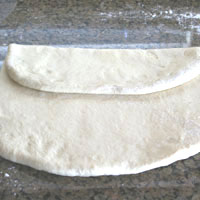
Fold the top third down. |
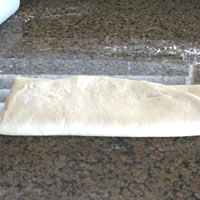
Fold the bottom third up and over the top third (like a letter). |
Turn it a quarter turn so the seams are on the top and bottom. |
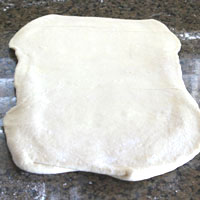
Roll out into a 9 x 12 inch rectangle. |
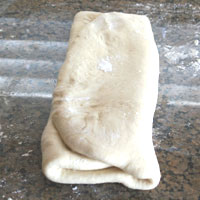
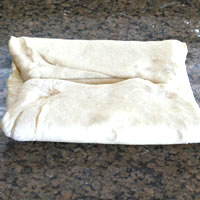
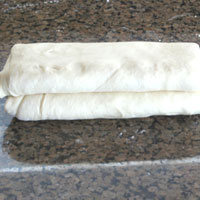
Fold the top third into the middle and the bottom third into the middle. |
Close like you would a book. |
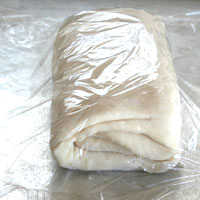
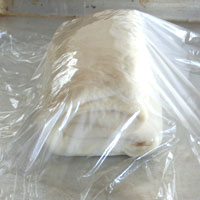
Cover in plastic wrap and refrigerate 1-2 hours. |
|
Phase 3 |
||
|
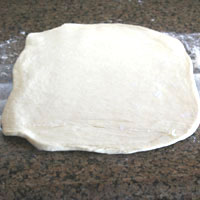
Remove from refrigerator and roll out into a 9 x 12 inch rectangle. |
Fold the top third down and the bottom third up. |
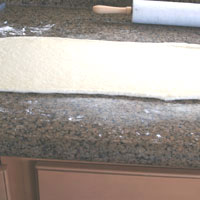
Roll out one last time into a 30 x 10 inch rectangle. |
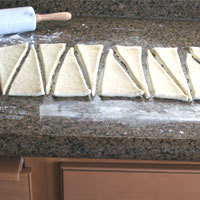
Cut into triangles 5 inches wide on top. |
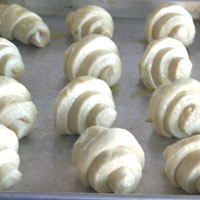
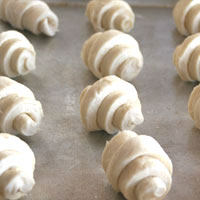
Roll up and place on a lightly greased baking sheet. |
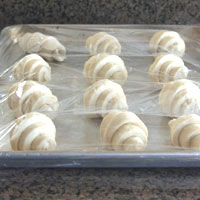
Cover completely in plastic wrap. Don’t wrap them too tight giving them room to rise. Refrigerate at least 2 hours and up to 24 hours. |
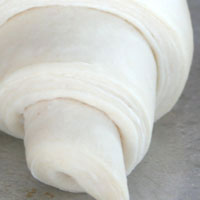
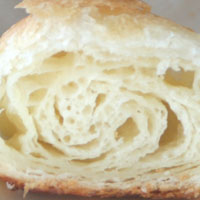
At this point look for the layers. You should see very thin layers evenly throughout the dough. |
|
Phase 4 |
||
Remove from refrigerator 1-2 hours before baking. Let them proof covered at room temperature. Preheat the oven to 400 degrees 15-20 minutes before baking. |
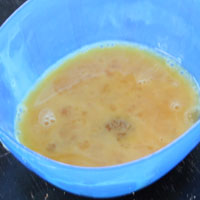
Just before putting them in the oven beat the egg and water with a fork. |
Brush each croissant with egg wash. |
1 egg 1 T cold water |
||
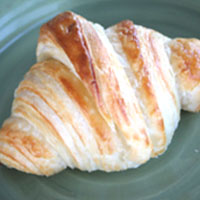
Bake 18-22 minutes until a deep golden brown on top. Remove to a cooling rack to keep them crisp. Serve hot or at room temperature. Leftovers do not keep well overnight. |
||
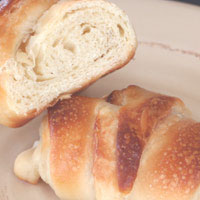
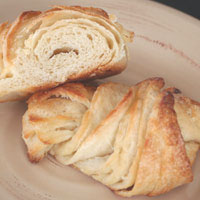
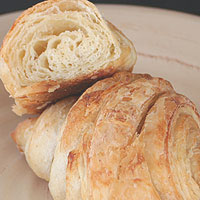
Problems Attempt #1 Chunky Butter: This is the biggest problem I encountered. If the butter is not completely pliable during the first few turns of the dough it will break and be in chunks throughout the dough. It is very important to get even layers of butter throughout the dough. You will be able to see the chunks if this is not happening. You will not be able to save the dough by this point, so I would recommend starting over and making sure the butter is completely pliable. Attempt #2 Thick layers: The final roll out of the dough should be ¼ inch or a bit less thick. If the dough is thicker than this the layers will be too thick giving it more of a roll texture rather than a croissant. Attempt #3 Thick rolls: Croissants are baked at a higher heat than normal rolls to make them flaky. Because of this the outside will brown faster. If the rolls are too thick in the middle they won’t have time to cook all the way through. Stick with the dimensions listed to bake them at 400 degrees. Layers The most important thing is to get consistent, thin layers throughout. If you are not seeing the striations it could be a few things: |
||
Croissants First and Second Turns Phase 4 Notes |
||

Recipes