The Perfect Chocolate Chip Cookie
variations included- lemon, toffee, M&M, macadamia, & more!
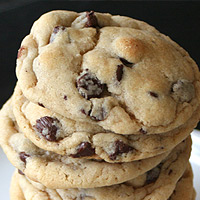
I have been on the search for the
Perfect Chocolate Chip Cookie for years. My friend, Daniella, makes perfect cookies and
taught me how. Below are step by step instructions to make your
own perfect cookies, as well as pictures of things that can go wrong.
We are sorry to lose all of the
comments that have been left over the years, but we are getting too much
spam. We decided to switch to a facebook comment format.
Feel free to comment again. We'd love to hear from you!
|
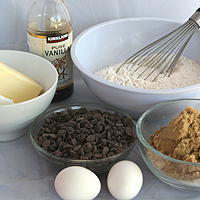
Assemble the ingredients to make sure you have everything. It's very frustrating to be halfway into a recipe and realize you're missing something. It can also ruin your cookies if some of the mixtures sit at room temperature too long while you get the missing items.
|
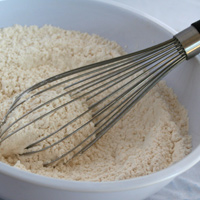
In a small bowl gently mix the flour, salt, and baking soda until
the ingredients are evenly distributed. Set aside.
|
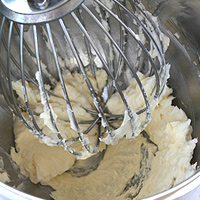
Using the wire whisk attachment of a stand
mixer, cream the butter and shortening on high until light and fluffy,
1-3
minutes.
|
2 3/4 c (14.5 oz)
all-purpose flour
1 t baking soda
1 t salt
1/2 c (4 oz) unsalted butter at room temperature
1/2 c (4 oz) Crisco (plain or butter flavored, I prefer plain)
Mixing the flour allows the final dough to have an even
distribution of ingredients without over-mixing it.
Beating the
butter and shortening gives the dough a better rise in the oven, making
the cookies lighter. Butter is good for taste and shortening is good to
make the cookie softer.
|
|
|
|
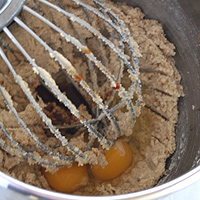
Add both sugars and beat on high 1-2 minutes. Add eggs and vanilla. Beat until fully incorporated.
|
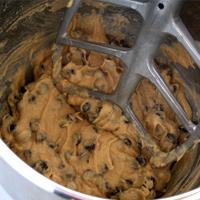
Switch to the paddle attachment.
Add the chocolate chips and mix gently. |
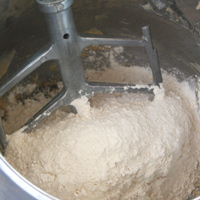
Add the flour mixture and mix until just incorporated. Do not overmix! |
1 c (6.5 oz) light brown sugar
1 c minus 2 T (6.5 oz) white sugar
2 large eggs
1 1/2 t vanilla
1 1/2 c (10 oz) semi-sweet chocolate chips (Hershey's brand is best)
Variations- replace chocolate chips with:
Lemon White
Chocolate- 1 T citric acid, 1 T lemon extract, 1 1/2 c white
chocolate chips
White Chocolate
Macadamia Nut- 3/4 c white chocolate chips, 3/4 c chopped
macadamia nuts
White Chocolate Craisin- 3/4 c white
chocolate chips, 3/4 c craisins
M&M- 1 c mini
M&Ms or 1 1/2 c regular M&Ms
Milk Chocolate Toffee-
1 1/2 c milk chocolate toffee bits
Adding
the chocolate chips before adding the flour evenly distributes them without
over-mixing the final dough. Do not over-mix or it will discolor
the dough.
The flour to be just incorporated, is the point when you no longer see white spots
of flour. Do not overmix! Over-mixing will ruin the
cookies. They will bake flatter and look greasy. See the
problem section for a picture of a very over-mixed cookie. |
|
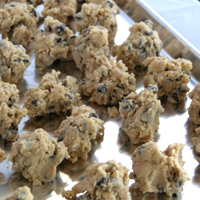
Touch test the dough. It should feel slightly sticky, but not much should stick to your finger. If it is very sticky add flour 2T (.5 oz) at a time. |
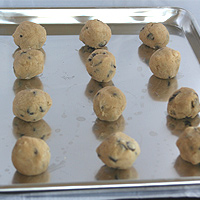
Using your hands, roll the dough into balls 1.5 inches tall
(1.5 oz). (For bigger cookies
see instructions below). Place on an ungreased cookie sheet 3 inches apart. |
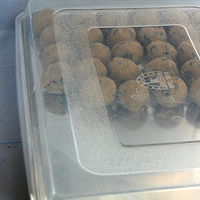
Cover and refrigerate 30 minutes or until firm.
You can hold the dough up to two days in the refrigerator or up to six
months in the freezer. |
When shaping the cookies, you
will know if you have the fat/flour ratio right.
too little flour-
it will stick to your hands, forms a messy looking ball
just right- won't stick to your hands, but just barely,
forms a smooth ball
too much flour- dough has to be
forced into a ball, crumbly dough, rough looking ball
The same
problems occur when over-handling the dough as over-mixing it.
They will bake flat and look greasy.
Handle the dough as little as possible while still shaping them
properly.
To freeze, place the dough balls on a plate side
by side, cover and freeze at least an hour. You can then bag them
and they won't be stuck together when you take them out. |
|
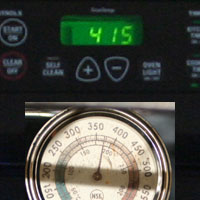
15-20 minutes before baking, position the oven
rack to the second highest setting. Preheat the oven to 375.
|
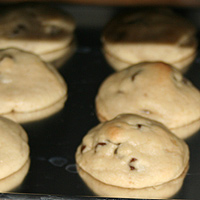
Remove the dough from the refrigerator and bake
8-10 minutes. They are ready to come out of the oven when they
are domed and puffy, show a few signs of browning and look a bit
underdone.
|
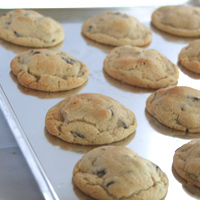
Leave the cookies on the cookie sheet for 2
minutes. |
It takes most ovens much
longer to preheat than when it beeps to tell you it's ready. An
oven thermometer is very helpful. When my oven beeps, it’s usually 50-100 degrees too low. It will ruin
the cookies to bake them at the incorrect temperature. My oven is also
calibrated incorrectly. I have to turn it to 385 degrees for it to actually be 375 degrees.
Determining when they are
done:
underdone- the are tall, shiny in
the middle, pale in color, fall apart when transfered,
fall through on the cooling rack
perfect- domed,
puffy, show a few signs of browning, look a bit underdone but are
not shiny on the top, hold together during transfer
overdone- flat, many brown spots, may break when
transfering, hard and crispy when cooled
If they cook faster
than 8 minutes the oven is too hot or the cookies are too small. If they take longer than 10 minutes the oven is too cool or the cookies are too big.
It is important to wait 2 minutes before transferring them.
They continue to bake from the heat of the sheet without being
over-baked in the oven. Also, they will hold together better
and be less likely to fall in the middle if you wait.
|
|
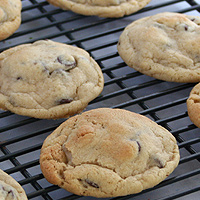
Remove them to a cooling rack
to cool evenly. |
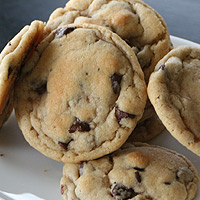
Wait ten minutes, then serve your Perfect Chocolate Chip Cookie! |
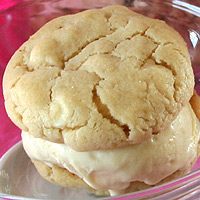
Lemon
cookies are great served with creamy vanilla ice
cream and berry syrup! |
|
Bigger Cookies
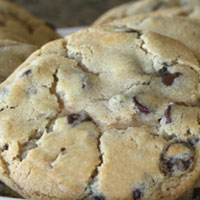
It was interesting to make the cookies bigger. They exterior was cracked like in problem cookie #9 below, but they had a perfect interior. The texture and consistency are just about the same as the smaller ones, but they look quite different.
|
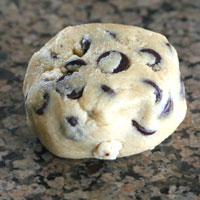
Roll a large piece of dough into a ball, then gently flatten the top and bottom into a thick disc shape about 1.5 inches tall. Each dough ball was 2.5 oz compared to 1.5 oz in the smaller cookies.
It is very important to flatten the top and bottom or it will not bake evenly. (See problem cookie #7.) |
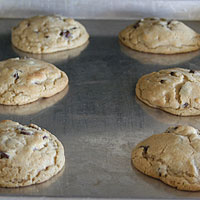
Bake 6 cookies per sheet for 10 minutes. Remove from oven and let cool on sheet for 2 minutes.
|
Remove them to a cooling rack and cool completely. |
Problems
|
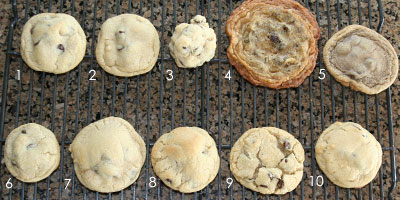
There are many variables in baking. Pictured are cookies with various problems using the same dough (with flour adjustments in numbers 3 &4).
1. This cookie is done just right. It is pictured to compare with the rest.
2. This dough was not refrigerated. It is still good but a little flatter than it should be.
3. This dough contained too much flour and did not spread much at all. It is interesting to note that the dough looked identical to the correct dough, but was much stiffer and drier.
4. This dough had too little flour. It spread too much and didn’t bake evenly.
5. This dough was over-mixed. It had a poor color, baked flat and had a strange consistency.
6. This dough was formed too small. It was overcooked at eight minutes. It is fine to make smaller cookies, just bake them for less time.
7. This dough was formed too large. The outsides were done while the middle was too high and underdone.
8. This dough was baked in an oven 25 degrees too hot. The outside was overdone and the inside was slightly underdone.
9. This dough was baked in an oven 25 degrees too cool. It fell flat and became too crisp without much of an inside.
10. This dough was frozen when baked. It took longer to
bake and didn’t cook as evenly. To use frozen dough, set on
cookie sheet at room temperature while oven is preheating, 15-20
minutes. It
takes the frost off and bakes perfectly.
|
 |
The Problem with Measuring Cups
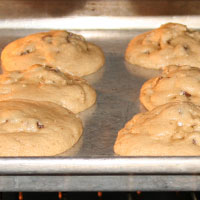
In these cookies I measured the shortening in a measuring cup rather than by a scale or by the package (Crisco sticks). When I later weighed how much shortening my 1/2 c measuring cups holds it was 1 oz too much. I have another 1/2 cup that measures 1 oz too little. As you can see the cookies baked flat and they tasted bad.
This could've been avoided had I used the same measuring cup each time or the more accurate way would've been to use crisco sticks every time instead of measuring cups.
The most accurate method is to weigh your ingredients. You will get consistent results each time. |
|
The Problem with Flour
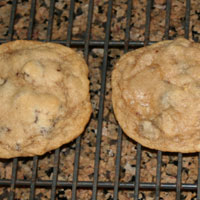
A lot of flour can be packed into a measuring cup. One cup is typically considered to be
5 oz. I ran a little test to weigh the differences in scooping flour.
I used the same measuring cup and the same bucket of flour. I put the measuring cup in, scooped out the flour, then leveled it with a knife.
Here are the results:
Scoop #1: 5.4 oz
Scoop #2: 4.6 oz
Scoop #3: 5.5 oz
Scoop #4: 4.7 oz
The differences are in how hard I scooped it. I
used a heavy hand in #3, and scooped lightly in #2. There was almost a
full ounce difference between the two. These differences can
greatly effect how your cookies turn out.
|
Tips and Tricks
Make Ahead
Frozen Dough
I love to keep
cookie dough on hand. These stay good up to 6 months in the
freezer.
Freezing
-I like to roll the dough into
individual balls and freeze them on a baking sheet. Then I
transfer them to a zipper-lock bag to store them long term. If you
put them in the bag before freezing them, they will stick together,
Baking
-Place the frozen dough on a baking sheet, then
heat the oven. When the oven is ready, bake 9-11 minutes (an
additional minute or two to the normal instructions).
-Baking it
directly from the freezer makes the edges crisp and the middle
under-done
Refrigerated Dough
Dough is good
up to 3 days in the refrigerator. |
Don't worry if they don't turn out. Write down exactly what you did and decide what you need to change the next time. Try it again soon so it is fresh in your memory.
|
Perfect Chocolate Chip Cookies
Daniella
2 3/4 c (14.5 oz) all-purpose flour
1 t baking soda
1 t salt
1/2 c (4 oz) unsalted butter at room temperature
1/2 c (4 oz) Crisco (plain or butter flavored, I prefer plain)
1 c (6.5 oz) light brown sugar
1 c minus 2 T (6.5 oz) white sugar
2 large eggs
1 1/2 t vanilla
1 1/2 c (10 oz) semi-sweet chocolate chips (Hershey's brand is best)
Variations- replace chocolate chips with:
Lemon White Chocolate- 1 T citric acid, 1 T lemon
extract, 1 1/2 c white chocolate chips
White Chocolate Macadamia Nut- 3/4 c white chocolate
chips, 3/4 c chopped macadamia nuts
White Chocolate Craisin-
3/4 c white chocolate chips, 3/4 c craisins
M&M-
1 c mini M&Ms or 1 1/2 c regular M&Ms
Milk Chocolate
Toffee- 1 1/2 c milk chocolate toffee bits
1. In a small bowl mix the flour, salt, and baking soda until the ingredients are
(1)evenly distributed. Set aside.
2. Using a wire whisk attachment of a stand mixer, (2)cream
the butter and shortening on high until light and fluffy 1-3 minutes.
3. Add both sugars and beat
on high 1-2 minutes. Add eggs and vanilla. Beat until fully incorporated.
4. Switch to a paddle attachment.
(3)Add the chocolate chips and mix gently.
5. Add the flour mixture and mix until
(4)just incorporated.
6. Touch test the dough. It should feel slightly sticky, but not much should stick to your finger. If it is very sticky add flour 2T (.5 oz) at a time.
If it is firm or dry, you have added too much flour and I don’t know
a good way to reverse this.
7. Using your (6)hands, roll the dough into balls 1.5 inches tall (for bigger cookies see instructions
above). Place on an ungreased cookie sheet 3 inches apart.
8. Cover and refrigerate 30 minutes or until firm. You can hold the dough up to two days in the refrigerator or up to
six months in the
(7)freezer.
9. (8)15-20 minutes before baking,
position the oven rack to the second highest setting. Preheat the
oven to 375.
10. Remove the dough from the refrigerator and bake
(9)8-10 minutes. They are ready to come out of the oven when
they are domed and puffy, show a few signs of browning and look a bit
underdone.
11. Leave the cookies on the cookie sheet for
(10)2 minutes. Remove them to a cooling rack so they will cool evenly. Wait ten minutes, then serve your Perfect Chocolate Chip Cookie!
Notes
1. Mixing the flour allows the final
dough to have an even distribution of ingredients without
over-mixing it.
2. Beating the
butter and shortening gives the dough a better rise in the oven,
making the cookies lighter. Butter is good for taste and
shortening is good to make the cookie softer.
3.
Adding the chocolate chips before adding the flour evenly distributes them
without over-mixing the final dough. Do not over-mix or it
will discolor the dough.
4.
Just incorporated
is the point when you no longer see white spots of flour. Do
not overmix! Over-mixing will ruin the
cookies. They will bake flatter and look greasy. See the
problem section for a picture of a very over-mixed cookie.
5. While shaping the dough, you will be able to tell if you have the fat/flour ratio right.
not enough flour-
it will stick to your hands, forms a messy
looking ball
just right- won't stick to your hands,
but just barely, forms a smooth ball
too much flour-
dough has to be forced into a ball, crumbly dough, rough looking
ball
6. The same problems occur
when over-handling the dough as over-mixing it. They will
bake flat and look greasy.
Handle the dough as little as possible while still shaping them
properly.
7. To freeze, place
the dough balls on a plate or baking sheet side by side, cover and freeze at
least an hour. You can then bag them and they won’t be
stuck together when you take them out.
8.
It takes most ovens much longer to preheat than when the oven
tells you it’s ready. I have an oven thermometer which is
very helpful. When my oven beeps telling me it’s ready,
it’s usually 50-100 degrees too low. It will ruin your
cookies to bake them at the incorrect temperature. My oven is also calibrated incorrectly. I have to turn it to
385 degrees for it to actually be 375 degrees.
9. Determining when they are done:
underdone- the are tall, shiny in the middle, pale in
color, fall apart when transfered from the cookie sheet, fall through on
the cooling rack
perfect- domed, puffy, show a few
signs of browning, look a bit underdone but are not shiny on the
top, hold together during transfer
overdone- flat,
many brown spots, may break when transfering, hard and crispy
when cooled
If they cook faster than 8 minutes the oven is too hot or the cookies are too small. If they take longer than 10 minutes the oven is too cool or the cookies are too big.
10. It is important to wait this 2
minutes. They continue to bake from the heat of the sheet
without being over-baked in the oven. Also, they will
hold together better and be less likely to fall in the middle if
you wait.
|